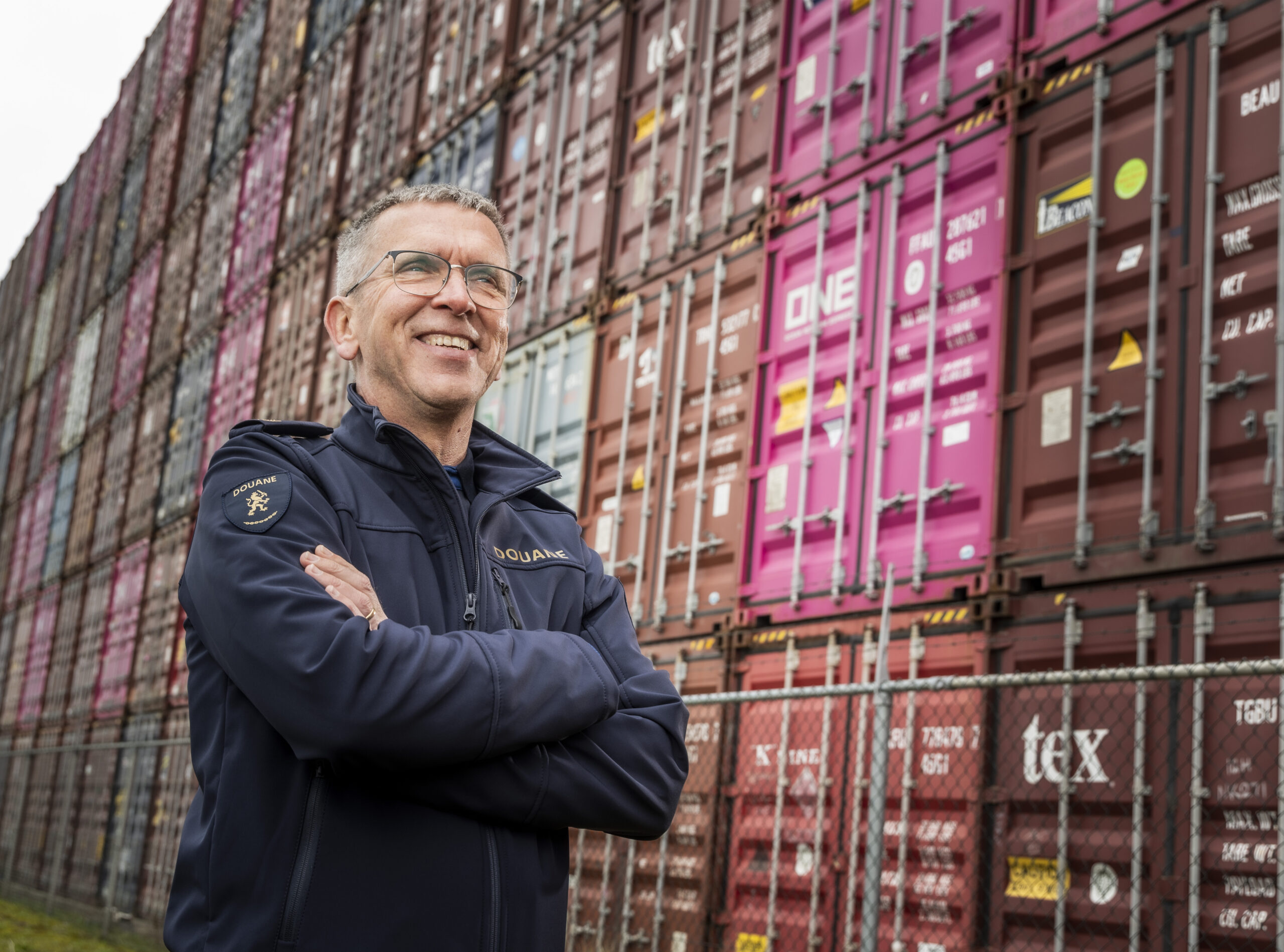
“The introduction of the Secure Chain has had a tremendous impact. We now encounter hardly any drug retrieval crews at participating container terminals,” observes Peter van Buijtenen, Regional Director of Customs for the port of Rotterdam. However, this does not mean that drug smuggling has stopped. Smugglers are always on the lookout for new opportunities. “This is why it is so important for the remaining shipping lines, ship agents and terminals in Rotterdam to also join the Secure Chain. The last thing you want is to put the safety of your employees at risk.”
Van Buijtenen points to a combination of measures, including higher fences, increased camera surveillance, stricter access controls and, last but certainly not least, the secure, PIN code-free release of import containers through the Secure Chain. As a result of these measures, drug retrieval crews are now rarely encountered at the deepsea terminals on the Maasvlakte. The rip-on/rip-off method, whereby drugs are secretly concealed in legitimate container shipments, has virtually disappeared from these terminals. However, there are still risks. Smuggling methods are constantly evolving. “As soon as one route is closed off, smugglers look for alternatives.” Reason for the senior customs official to stress the importance of widespread participation in the Secure Chain: “Companies in the port must ensure they do not become the weakest link – the point at which security is most vulnerable and smuggling is therefore easiest.”
“The last thing any company wants is to put the safety of its employees at risk.”
Minimise the opportunities for criminal exploitation
“We know that smuggling routes shift,” Van Buijtenen continues. “Drugs first travel from Latin America to West Africa and then make their way towards us, sometimes via Spain and Portugal.” So far, the number of drug seizures linked to these routes has remained relatively low, but Van Buijtenen believes that taking a wait-and-see approach is the worst thing companies can do. After all, Rotterdam is connected to Southern Europe and West Africa through numerous regular shipping services. The problem of drug retrieval could easily re-emerge, along with the associated risks of employees being threatened or coerced into criminal activity. “I think this was also a major turning point for the terminals and shipping lines that are already participating in the Secure Chain. Once their own employees started being threatened, they really began to take notice.” Van Buijtenen’s message is clear: don’t wait until it is too late. “The best time to fix the roof is when the sun is shining. Organise your processes in such a way that criminals have as little opportunity as possible to exploit weaknesses, both now and in the future.”
Dutch Customs also tightening its processes
Dutch Customs is also continuously working to improve its own processes. The risk analyses underpinning customs inspections are regularly reviewed. One specific measure currently under consideration is decreasing the advance notification period for customs inspections. By shortening the time between notification of an inspection – currently 72 hours before a vessel arrives – and the actual inspection, criminals will have less opportunity to organise drug retrieval operations. Dutch Customs is currently consulting with the business community on how and when this measure should be introduced. Van Buijtenen: “Together with our partners, we are also studying how the container scanning process can be optimised.” The aim is to increase both the number of containers scanned and the speed of scanning. This is not just a government priority. “Businesses have a clear desire to ensure the security of their cargo. For example, we are in discussions with a company that, because of its trade with high-risk countries, would prefer all its incoming containers to be scanned. There is a genuine need for security throughout the chain. Alongside other measures, the Secure Chain is an essential part of achieving this.”